Choosing a new furnace is not simply a matter of looking at your home’s square footage and picking a BTU number from a chart. Two homes with the same floor area can have very different heating requirements because of insulation, windows, air leakage, ceiling height, layout, ductwork, and other factors.
So, how do you know what size furnace you need? The short answer is that the right furnace size should be based on your home’s actual heating requirements and heat loss, not floor area alone. Furnace capacity is commonly measured in BTUs per hour, but the highest BTU rating is not necessarily the best choice.
This furnace size guide explains what furnace BTU ratings mean, how professionals approach furnace sizing, why oversized and undersized equipment can cause problems, and what Burnaby homeowners should consider before replacing an existing furnace.
What Does Furnace Size Actually Mean?
When HVAC professionals talk about furnace “size,” they are generally referring to the unit’s heating capacity rather than its physical dimensions. A furnace’s capacity indicates how much heat it is designed to provide, while its physical dimensions determine how much space the equipment occupies.
For homeowners, understanding this distinction is important. A physically larger furnace is not automatically a higher-capacity furnace, and a furnace with a higher BTU rating is not automatically better for a particular home.
What Is a BTU?
BTU stands for British thermal unit, a measurement of heat energy. Furnace capacity is commonly expressed in BTUs per hour, which indicates the amount of heating energy the equipment is designed to deliver over time.
For example, when a furnace is described by a BTU rating, that number relates to its heating capacity. It does not describe the furnace’s physical size.
More BTUs can mean greater heating capacity, but that capacity needs to match the home’s heating load. Installing more heating capacity than the home requires can create its own problems.
Why Bigger Is Not Always Better
It is easy to assume that a larger furnace will heat a home faster and provide better comfort. In reality, an oversized furnace may reach the thermostat setting quickly and shut down before operating through an appropriate heating cycle.
The opposite can happen with an undersized furnace. If its heating capacity is insufficient for the home’s demand during colder conditions, it may have difficulty maintaining the desired indoor temperature.
The objective of furnace sizing is therefore not to choose the biggest unit that fits. It is to select a furnace with heating capacity appropriate for the home’s requirements.
How Is Furnace Size Determined?
Proper furnace sizing starts with understanding the home’s heating load. In simple terms, the heating load represents how much heat the home loses under cold outdoor conditions and how much heat the furnace needs to provide to maintain comfortable indoor temperatures.
This is why professional sizing involves much more than multiplying square footage by a fixed BTU number.
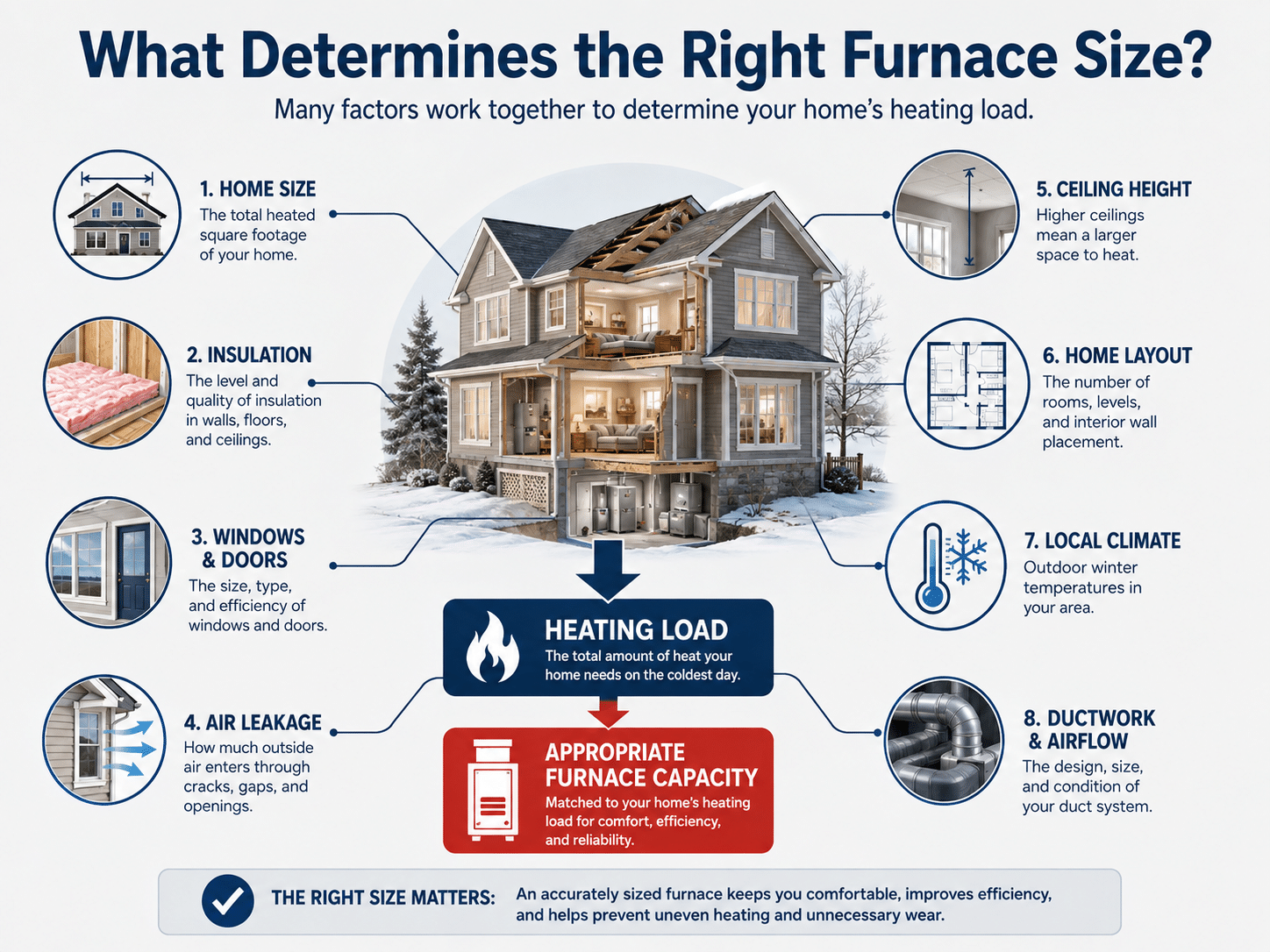
Home Size and Square Footage
Square footage is useful information, but it is only one part of the sizing picture.
A 2,000-square-foot home with good insulation, efficient windows and limited air leakage may have significantly different heating requirements from another 2,000-square-foot home with older windows, minimal insulation and noticeable drafts.
This is why a furnace size by square footage chart can be useful for initial research but should not be treated as a final sizing calculation.
Insulation and the Building Envelope
The condition of the building envelope has a direct effect on heat loss. Insulation in walls, ceilings and other areas helps slow the transfer of heat between the home and outdoors.
Older homes may also have characteristics that affect heating demand differently from newer construction. Improvements such as additional insulation and air sealing can reduce heat loss, which may change the heating capacity a home needs when its furnace is eventually replaced.
Windows, Doors and Air Leakage
Windows and exterior doors are another important consideration. Their number, size, condition and performance can affect how much heat escapes.
Uncontrolled air leakage matters as well. Drafts around doors, windows and other parts of the building envelope can increase heating demand.
A professional furnace sizing assessment considers these characteristics instead of assuming that every home of a particular size loses heat at the same rate.
Ceiling Height and Home Layout
Floor area does not tell you everything about the space being heated.
Ceiling height, the number of floors, open-concept areas, finished basements and the arrangement of rooms can all influence heating requirements. A home with high ceilings, for example, has more air volume to heat than a similarly sized home with standard-height ceilings.
The layout can also affect how heated air is distributed throughout the property.
Local Climate and Design Conditions
Furnace sizing must also account for outdoor heating conditions. A heating system needs to provide adequate capacity for the conditions it is expected to encounter during colder weather.
For homeowners in Burnaby, local climate conditions are part of the overall sizing assessment. The goal is to select equipment capable of meeting the home’s heating requirements without relying on a generic BTU-per-square-foot assumption.
Can You Calculate Furnace Size From Square Footage?
You can use square footage to get a general idea of furnace capacity, but it should not be used as the sole basis for choosing equipment.
Online furnace BTU calculators and sizing charts can be useful when researching replacement options. Their limitation is that simplified calculations cannot account for every characteristic of an individual home.
Why Square-Footage Rules Are Only Estimates
A simple square-footage formula treats homes as though they have similar insulation, windows, construction and heat-loss characteristics. Real homes are rarely that uniform.
Using an overly broad estimate could result in selecting a furnace that is larger or smaller than the home’s actual requirements. That is why square footage should be viewed as a starting point rather than a final answer.
What a Professional Furnace Sizing Assessment Looks At
A more complete sizing assessment can consider:
- Home dimensions and square footage
- Number of floors
- Ceiling heights
- Insulation levels
- Windows and exterior doors
- Air leakage
- Building orientation and exposure
- Home layout
- Existing ductwork
- Existing heating equipment
- Local heating conditions
These factors help create a more realistic picture of the home’s heating load.
What Happens If a Furnace Is Too Large?
An oversized furnace can create problems even though it has enough or more than enough capacity to heat the home.
Short Cycling
One common concern is furnace short cycling. The furnace heats the space quickly, reaches the thermostat’s target temperature, shuts off, and then starts again after the temperature falls.
Repeated starts and stops can affect comfort and system operation. Instead of assuming that faster heating is better, homeowners should consider whether the furnace is appropriately matched to the home’s heating load.
Uneven or Inconsistent Comfort
An oversized furnace does not guarantee even temperatures throughout the home. Some areas may become warmer quickly while other rooms remain less comfortable.
Comfort depends on more than furnace capacity. Airflow, ductwork, insulation, room layout and thermostat location can all play a role.
Potential Efficiency and Equipment Concerns
Frequent cycling can also create additional operating demands because the furnace repeatedly starts and stops. While the exact impact depends on the equipment and installation, an oversized furnace is not automatically the more efficient choice simply because it has greater capacity.
Proper sizing should therefore be considered alongside furnace efficiency and installation quality.
What Happens If a Furnace Is Too Small?
An undersized furnace presents the opposite problem. Instead of reaching the thermostat setting quickly, it may struggle to keep up when the home has a high heating demand.
Difficulty Maintaining the Desired Temperature
During colder conditions, an undersized furnace may have difficulty maintaining the temperature homeowners expect.
The system may run for longer periods as it attempts to satisfy the thermostat. Longer operation is not inherently a fault—properly sized systems can run for extended periods—but persistent difficulty maintaining indoor temperature deserves attention.
Increased Operating Demands
When heating capacity does not adequately match demand, the furnace may need to operate for longer periods to provide the required heat.
The actual effect on energy use depends on many factors, including equipment efficiency, weather, insulation and system condition. The important point is that furnace capacity should be appropriate for the home’s heating requirements.
Why Undersizing Can Be Just as Problematic
The answer to an oversized furnace is not simply to choose the smallest available replacement. Correct furnace sizing means finding the appropriate balance between heating demand and furnace capacity.
The goal is reliable comfort—not the biggest or smallest BTU number.
Does Your Existing Furnace Tell You What Size Replacement You Need?
Your existing furnace can provide useful information, but it should not automatically determine the size of your replacement furnace.
Why You Shouldn’t Automatically Match the Existing Furnace
The previous furnace may have been oversized or undersized. In addition, your home may no longer have the same heating requirements.
Perhaps the windows have been replaced. Maybe insulation has been upgraded, a basement has been finished, or an addition has changed the home’s layout. These changes can affect heat loss.
Replacing an old 80,000-BTU furnace with another 80,000-BTU furnace simply because “that’s what was there before” does not necessarily mean the new system is correctly sized.
What to Check on the Existing Furnace
The furnace’s model and rating information can usually be found on its equipment data plate or label. Homeowners replacing a furnace should keep the model number and available equipment records and provide them to their HVAC professional.
This information helps establish what is currently installed, but it should be considered alongside the home’s current heating requirements.
Furnace Size vs. Furnace Efficiency: What’s the Difference?
Furnace capacity and efficiency are related to heating performance, but they describe different things.
Furnace Size Is Heating Capacity
Furnace size primarily refers to heating capacity, commonly expressed in BTUs per hour. It tells you how much heating output the equipment is designed to provide.
A furnace can have a high efficiency rating and still be incorrectly sized for the home.
Furnace Efficiency Is How Effectively the Furnace Uses Fuel
Efficiency describes how effectively a furnace converts its fuel into usable heat. A high-efficiency furnace can deliver the required heat while using fuel more effectively than a lower-efficiency model under comparable conditions.
Why Both Matter When Choosing a New Furnace
A replacement decision should consider more than a single number.
Homeowners should look at:
- Appropriate heating capacity
- Furnace efficiency
- Heating requirements
- Ductwork and airflow
- Thermostat compatibility
- Installation requirements
- Overall system condition
The right furnace is one that fits the home’s requirements and works properly as part of the complete HVAC system.
How Professional Furnace Sizing Helps Homeowners
Professional furnace sizing is valuable because the furnace is only one part of the home’s heating system.
Heating-Load Assessment
A heating-load assessment evaluates the home’s characteristics and estimates its heating requirements under appropriate conditions.
Instead of asking, “How many BTUs do homes this size usually need?” the better question is, “How much heat does this particular home lose, and what capacity is appropriate to replace that loss?”
That distinction is at the heart of accurate furnace sizing.
Ductwork and Airflow Considerations
Even a properly sized furnace cannot compensate for inadequate airflow or poorly performing ductwork.
Return-air capacity, supply-air distribution and the condition of existing ducts can influence how effectively heat reaches different areas of the home.
That is why furnace capacity should be evaluated as part of the complete heating system rather than in isolation.
Thermostat and System Compatibility
The thermostat and other controls should also be considered when replacing equipment. Depending on the furnace selected, control requirements and operating characteristics can differ.
A professional assessment helps ensure the replacement furnace is compatible with the home’s existing system or identifies upgrades that may be appropriate.
The right furnace size isn’t simply the largest furnace that will fit the home. The equipment should be selected based on the home’s heating requirements and the characteristics that affect heat loss.
7 Common Furnace Sizing Mistakes Homeowners Make
- Choosing a furnace based only on square footage
Square footage is a useful starting point, but it does not account for insulation, windows, air leakage, ceiling height or other heat-loss factors.
- Assuming the biggest furnace is the best
More BTUs do not automatically mean better comfort. An oversized furnace may cycle more frequently.
- Automatically replacing the existing furnace with the same size
The old equipment may not have been correctly sized, and your home’s heating requirements may have changed.
- Ignoring insulation and air leakage
A home’s building envelope affects how much heat it loses. Better insulation and reduced air leakage can change heating requirements.
- Ignoring ductwork and airflow
Furnace capacity is only part of the system. The ductwork needs to support the required airflow and distribution.
- Focusing only on BTUs and ignoring efficiency
Capacity determines heating output, while efficiency affects how effectively the furnace uses fuel. Both deserve consideration.
- Treating an online furnace calculator as the final answer
Online calculators can help with research, but they cannot replace a property-specific heating-load assessment.
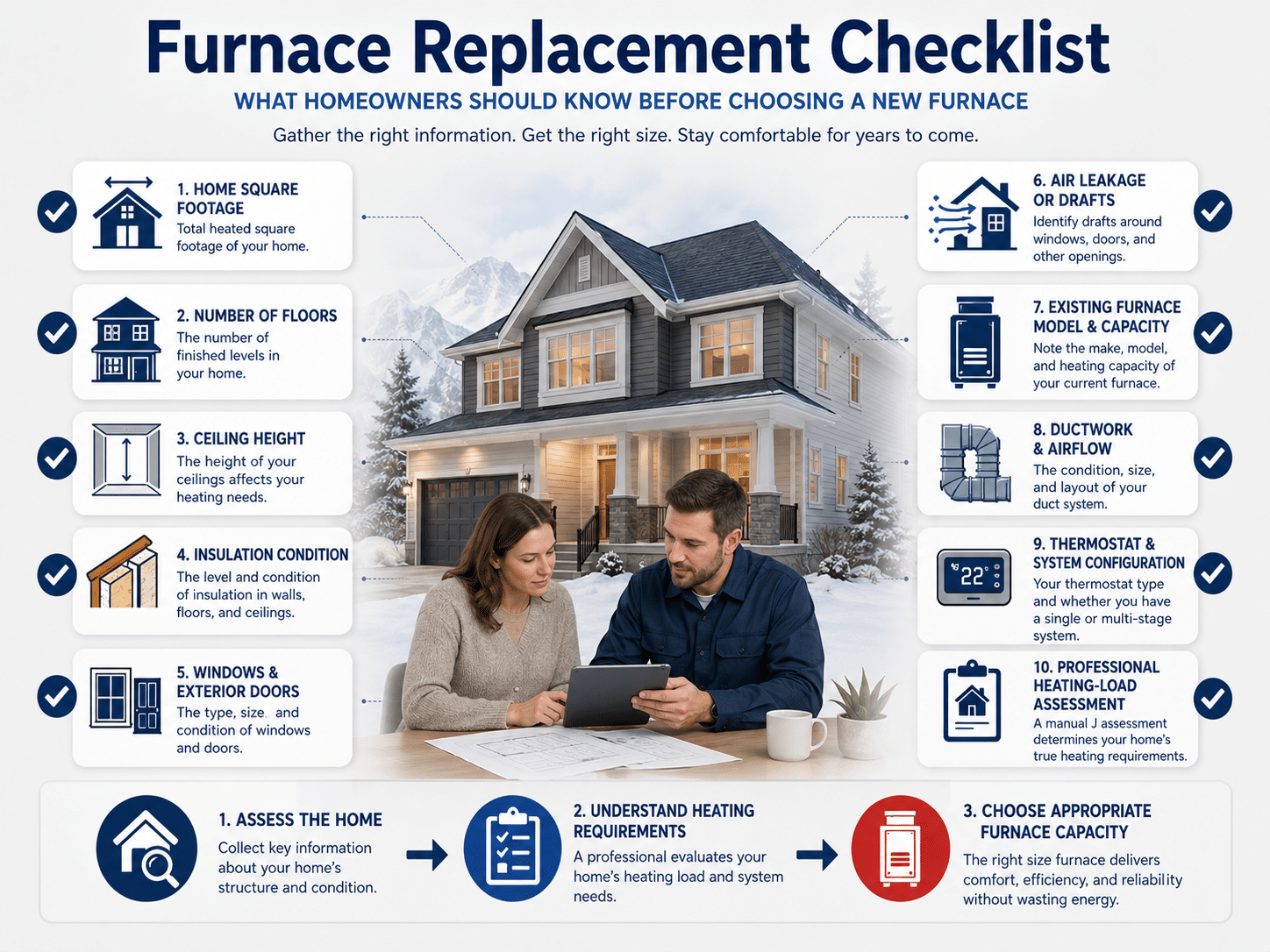
A Simple Furnace Sizing Checklist for Homeowners
Before replacing your furnace, gather the following information:
- Home square footage
- Number of floors
- Ceiling height
- Insulation condition
- Window and door condition
- Areas with noticeable drafts
- Existing furnace model number
- Existing furnace capacity
- Existing ductwork and airflow concerns
- Thermostat and control configuration
- Any recent renovations or additions
- Any history of short cycling or difficulty maintaining temperature
- Professional heating-load assessment
Having this information available can make a furnace replacement consultation more productive and help your HVAC professional understand the home before recommending equipment.
When Should You Have a Professional Size of Your Furnace?
You’re Replacing an Older Furnace
Furnace replacement is an opportunity to reassess the home’s heating requirements rather than automatically copying the existing equipment.
Your Home Has Been Renovated
Additions, finished spaces, insulation upgrades, new windows and changes to the home’s layout can all affect heat loss. A new furnace should reflect the home’s current condition.
Your Current Furnace Short Cycles or Struggles to Keep Up
Short cycling or difficulty maintaining temperature can have several possible causes, so these symptoms do not automatically prove incorrect furnace sizing. However, they are good reasons to have the heating system evaluated.
You’re Unsure Which Furnace BTU Capacity You Need
If you’re comparing furnaces and unsure whether a particular BTU rating is appropriate, professional sizing is safer than relying on a generic online chart.
For homeowners considering furnace replacement in Burnaby, Canadian Pacific Heating & Cooling can evaluate the home’s heating requirements and help identify equipment that is appropriately matched to the property.
Conclusion: Choosing the Right Furnace Size
The right furnace size is determined by the home’s actual heating requirements—not simply by square footage or the BTU rating printed on the old furnace. Heat loss, insulation, windows, air leakage, ceiling height, home layout, ductwork and local heating conditions all influence the capacity a home needs.
Choosing an oversized furnace does not guarantee better comfort, just as choosing an undersized furnace does not guarantee lower operating costs. The goal is to match heating capacity with the home’s demand while also considering efficiency, airflow and system compatibility.
If you’re replacing an aging furnace or simply unsure whether your current system is appropriately sized, a professional assessment can help you avoid guessing. Canadian Pacific Heating & Cooling can evaluate your home’s heating requirements and help you select a furnace that is properly matched to your property and comfort needs.