Choosing the right HVAC company in Burnaby starts with looking beyond the price of a repair or installation. Homeowners should consider the contractor’s qualifications, residential experience, reputation, range of services, written estimates, warranty terms, and ability to clearly explain the recommended work. A reliable contractor should help you understand your options rather than pressure you into a decision.
The right choice matters because HVAC work directly affects your home’s comfort, energy use, and system reliability. An incorrectly diagnosed problem, poorly installed component, or unsuitable system can lead to recurring repairs and unnecessary expenses. Working with a contractor familiar with residential HVAC systems can help reduce these risks.
This article explains what to check before hiring an HVAC contractor in Burnaby, including local experience, customer reviews, quotes, warranties, important questions to ask, and warning signs to watch for. It also explains how to compare repair and replacement options before making your final decision.
What Should You Look for in an HVAC Company in Burnaby?
When comparing an HVAC company in Burnaby, start with the basics: appropriate qualifications, insurance, residential experience, and a clear approach to diagnosing HVAC problems. These factors can tell you more about a contractor’s suitability than a low advertised price. For repairs or installations, ask whether the company has experience working with the type of furnace, heat pump, air conditioner, or other equipment in your home.
Residential HVAC experience also matters because every home is different. The system that works well in one property may not be appropriate for another because of differences in home size, layout, insulation, existing ductwork, and heating or cooling requirements. An experienced HVAC contractor should assess these factors before recommending a solution.
It is also worth paying attention to how the contractor communicates. A professional should explain what they found, why a particular repair or replacement is being suggested, and what your available options are. Clear answers, written estimates, realistic timelines, and straightforward warranty information make it easier to make an informed decision. If a contractor avoids basic questions or immediately pushes expensive work without explaining the diagnosis, consider that a warning sign.
Why Local HVAC Experience Matters in Burnaby
Choosing a local HVAC contractor in Burnaby can be useful because the contractor is more likely to understand the heating and cooling demands homeowners face in the Lower Mainland. Burnaby homes vary considerably in age, construction, layout, insulation, and existing HVAC equipment. Those differences can affect how a system should be serviced, repaired, maintained, or replaced.
Local experience can also make it easier for a contractor to understand seasonal heating requirements and the increasing need for effective cooling during warmer periods. A contractor familiar with local residential properties can consider the home itself, rather than treating every HVAC problem as a standard repair or installation.
However, being local does not automatically make a company the right choice. Homeowners should still check qualifications, relevant residential experience, customer feedback, written estimates, warranty information, and communication. The goal is to find a local HVAC company that combines accessibility with professional workmanship and sound recommendations.
For Burnaby homeowners, the best contractor is not necessarily the closest or cheapest option. It is the company that can understand the home’s requirements, clearly explain the available solutions, and provide dependable service before, during, and after the work.
Check the Services Offered Before Hiring
Before choosing an HVAC company, check whether its services match your home’s current and potential future needs. A contractor that handles both heating and cooling can make ongoing HVAC care more convenient, especially when the same team becomes familiar with your home’s equipment and service history.
Depending on your system and property, useful residential HVAC services may include:
- Furnace repair and installation for heating problems, system upgrades, or replacement needs.
- AC repair and installation to keep your home comfortable during warmer months.
- Heat pump services for homeowners considering an alternative heating and cooling solution.
- HVAC maintenance to identify worn components, airflow issues, and developing problems before they become larger repairs.
- Indoor air quality services for concerns involving filtration, ventilation, dust, humidity, or inconsistent airflow.
- Thermostat troubleshooting when temperature control or communication with the HVAC system is not working properly.
A broad service range is useful, but homeowners should not choose a contractor simply because it lists many services. The company should have relevant experience with the equipment installed in your home and be able to explain what actually needs to be done. For example, if your furnace is experiencing repeated problems, a qualified HVAC technician should diagnose the underlying issue before recommending a replacement.
It is also worth asking whether the contractor provides maintenance and follow-up service after an installation or major repair. Having one reliable HVAC company for ongoing service can make it easier to keep track of maintenance needs and address smaller problems before they develop into more expensive HVAC issues.
Ultimately, the right service range is one that supports your home’s actual heating, cooling, and comfort requirements. Look for an HVAC contractor that combines appropriate services with accurate diagnosis, clear communication, and professional workmanship.

Compare Reviews, Quotes, and Warranties
Once you have shortlisted a few HVAC companies, compare more than their overall ratings or advertised prices. Reviews can reveal patterns in communication and workmanship, while written quotes and warranty terms help you understand what you are actually paying for. Consumer Protection BC also recommends researching contractors, checking reviews, shopping around, and looking closely at differences between estimates rather than automatically choosing the lowest one.
| What to Compare | What to Look For |
| Customer reviews | Repeated comments about workmanship, communication, punctuality, and follow-up service |
| Written quote | Equipment or repair details, labour, materials, scope of work, and total cost |
| Warranty | Manufacturer coverage, labour or installation coverage, exclusions, and warranty requirements |
| Service terms | Maintenance recommendations, follow-up support, and what happens if an issue returns |
Read Reviews for Patterns
Do not judge an HVAC company only by its star rating. Read several recent reviews and look for consistent feedback about how the company communicates, handles unexpected problems, completes installations, and responds after the work is finished. A few negative reviews do not necessarily mean a contractor is unreliable, but repeated complaints about similar issues deserve attention.
Compare the Complete HVAC Quote
A lower quote is not automatically a better deal. Two contractors may recommend different equipment, include different amounts of labour, or have different scopes of work. Natural Resources Canada recommends getting written quotes and comparing contractors before starting home energy work.
For a major HVAC installation, compare the equipment being proposed, installation work, required modifications, warranty information, and total price. This makes it easier to identify whether one contractor is simply offering a lower price or actually providing better overall value.
Understand Warranty Coverage
Warranty terms should be clear before you approve the work. Manufacturer warranties can differ from installation or labour warranties, and coverage may have specific conditions. Natural Resources Canada advises homeowners to understand warranty details and ask the contractor or manufacturer for clarification when necessary.
If a contractor cannot clearly explain what is covered, how long coverage lasts, or who handles a warranty claim, ask for the information in writing before signing the agreement. A clear warranty does not replace good workmanship, but it can give you a better understanding of your protection after the HVAC work is completed.
Questions to Ask an HVAC Contractor Before Hiring
Asking the right questions can reveal how an HVAC contractor approaches your home, equipment, and proposed work. You do not need to understand every technical detail. The goal is to make sure the contractor can explain the problem, the recommended solution, the expected cost, and the work involved clearly. Asking for written details is particularly useful when comparing contractors or considering a major installation.
Questions About the Contractor
- Are you properly qualified and insured for the work?
Ask what qualifications apply to the specific HVAC work being performed and whether the company carries appropriate insurance. - How much residential HVAC experience do you have?
Experience with residential systems can be more relevant than simply knowing how long a company has operated. - Will your own technicians complete the work, or will another contractor be involved?
Knowing who will actually perform the installation or repair can help you understand who is responsible for the work. - Can you provide a written estimate or scope of work?
A written document makes it easier to compare what different HVAC companies are actually offering.
Questions About the Recommended Work
- What is causing the HVAC problem, and how did you diagnose it?
For a repair, ask the technician to explain the underlying issue and what testing or inspection led to the recommendation. - Is repair the best option, or should I consider replacement?
Ask the contractor to explain both options when appropriate instead of assuming replacement is automatically necessary. - How did you determine the equipment size for my home?
For a replacement, the recommendation should consider the home and its heating or cooling requirements rather than simply copying the size of the existing equipment. - What exactly is included in the quoted work?
Ask whether labour, equipment, materials, removal, installation changes, permits where applicable, cleanup, and other necessary work are included.
Questions About Follow-Up Service
- What warranty applies to the equipment and the installation?
Ask about manufacturer coverage separately from the contractor’s labour or installation warranty. - What maintenance will the system need after the work is completed?
Understanding maintenance requirements can help you protect the equipment and identify potential problems early. - Who should I contact if something goes wrong after the work?
Make sure you know how follow-up service and warranty concerns are handled. - What happens if additional work is discovered after the job starts?
Ask whether the contractor will explain the issue and obtain your approval before adding unexpected costs.
A professional contractor should be comfortable answering reasonable questions and explaining the work without unnecessary pressure. Canada’s Mortgage and Housing Corporation similarly recommends asking contractors about previous experience, warranties, insurance, written contracts, schedules, cleanup, and required permits when hiring for home projects.
For homeowners comparing a local HVAC contractor in Burnaby, the quality of the answers matters as much as the answers themselves. Clear explanations, written details, and a willingness to discuss alternatives can make the hiring decision much easier.
HVAC Contractor Red Flags to Watch For
Even after comparing HVAC companies, homeowners should pay attention to how a contractor behaves during the consultation and quoting process. A low price or attractive offer can become less appealing if the contractor avoids questions, provides unclear information, or pressures you to approve work before you have time to compare your options. Consumer Protection BC specifically advises consumers to research contractors, compare quotes, review contracts carefully, and avoid high-pressure sales tactics.
Pressure to Approve Work Immediately
Be cautious if an HVAC contractor insists that you must make a decision immediately or claims an offer is available only for a very short period. A major furnace, heat pump, or air conditioner purchase deserves time for comparison.
Warning signs include:
- Being told you must sign or pay immediately.
- Pressure to approve replacement before the problem is properly explained.
- A salesperson discouraging you from getting another quote.
- Claims that you cannot take time to review the agreement.
- Unexpected pressure to accept financing or a long-term payment arrangement.
A reputable contractor should give you enough information to understand the recommendation and make a considered decision.
Unclear Pricing or Written Estimates
Another warning sign is a quote that does not clearly explain what you are receiving for the stated price. Before agreeing to major HVAC work, make sure the scope, equipment or repair, labour, payment terms, and other applicable costs are understandable.
Watch for:
- Verbal prices with no written estimate or agreement.
- Vague descriptions of the work.
- Unexpected charges that were not explained beforehand.
- Financing terms that are difficult to understand.
- Requests for an unusually large deposit without a clear reason.
For certain consumer contracts in BC, required contract information and consumer rights can apply, so homeowners should read the agreement carefully before signing.
Poor Communication
Communication problems before the work starts can become more frustrating once a project is underway. If a contractor repeatedly avoids straightforward questions, does not explain the diagnosis, or fails to provide requested documentation, consider whether you are comfortable trusting them with your HVAC system.
Take extra care when a contractor:
- Cannot clearly explain why a repair or replacement is recommended.
- Avoids discussing alternatives when appropriate.
- Does not explain warranty coverage.
- Changes the quoted scope without clear communication.
- Becomes difficult to reach when you ask reasonable questions.
The goal is not to find a contractor who never encounters an unexpected issue. HVAC systems can present genuine complications. What matters is whether the contractor communicates the issue clearly, explains the available options, and gets your agreement before significant changes to the work or cost.
Repair or Replacement? Choose a Contractor Who Explains Both Options
When an HVAC system develops a major problem, homeowners are often faced with a difficult choice: repair the existing equipment or replace it. A trustworthy HVAC contractor should explain both possibilities when appropriate, including the condition of the system, the cause of the problem, expected repair requirements, and the potential benefits of replacement. The decision should be based on the home’s needs and the system’s condition rather than pressure to purchase new equipment.
| Consideration | Repair May Make Sense | Replacement May Be Worth Considering |
| System condition | Equipment is generally reliable with a specific repairable fault | System has repeated or major problems |
| Repair cost | Repair is reasonable compared with the system’s condition | Major component or multiple repairs make costs harder to justify |
| Efficiency | Existing system still performs adequately | New equipment may offer improved efficiency |
| Reliability | Few recent breakdowns | Frequent breakdowns or declining performance |
| Long-term plans | You expect to keep the existing system | You want a longer-term heating or cooling solution |
When Repair May Make Sense
Repair can be a sensible option when the HVAC system is otherwise in good condition and the problem is isolated. A contractor should diagnose the actual fault before recommending a repair and explain what the repair is expected to accomplish.
Ask what caused the failure, whether other components show signs of wear, and whether the repaired system is likely to continue meeting your home’s heating or cooling requirements. Regular maintenance also matters because properly maintained HVAC equipment can operate more efficiently and reliably.
When Replacement May Be Worth Considering
Replacement deserves consideration when the system has recurring problems, major component failures, declining performance, or repair costs that no longer make practical sense. New equipment may also provide efficiency or comfort improvements, but the contractor should still assess the home’s requirements before recommending a particular system.
For example, Natural Resources Canada advises that cooling systems should be properly sized based on the home’s cooling load rather than simple rules of thumb. This is why a replacement quote should explain why the proposed equipment is appropriate for your home instead of simply matching the size of the old unit.
A replacement recommendation should start with diagnosis and system assessment, not equipment selection. Ask the contractor to explain why replacement is being considered and what evidence supports the recommendation.
If you are comparing a repair with a new installation, consider the immediate cost alongside expected reliability, equipment condition, efficiency, warranty coverage, and future maintenance needs. The cheapest short-term option is not necessarily the best long-term value.
If you need help evaluating heating or cooling problems in your Burnaby home, Canadian Pacific Heating & Cooling can assess your HVAC system and explain the available service options before you decide how to proceed.
How to Make Your Final HVAC Company Decision
After researching contractors, comparing quotes, and asking questions, the final decision should come down to overall value rather than one factor such as price. A good HVAC company should give you enough information to understand what work is needed, why it is recommended, what it will cost, and what support you can expect afterward.
Use a Simple Contractor Checklist
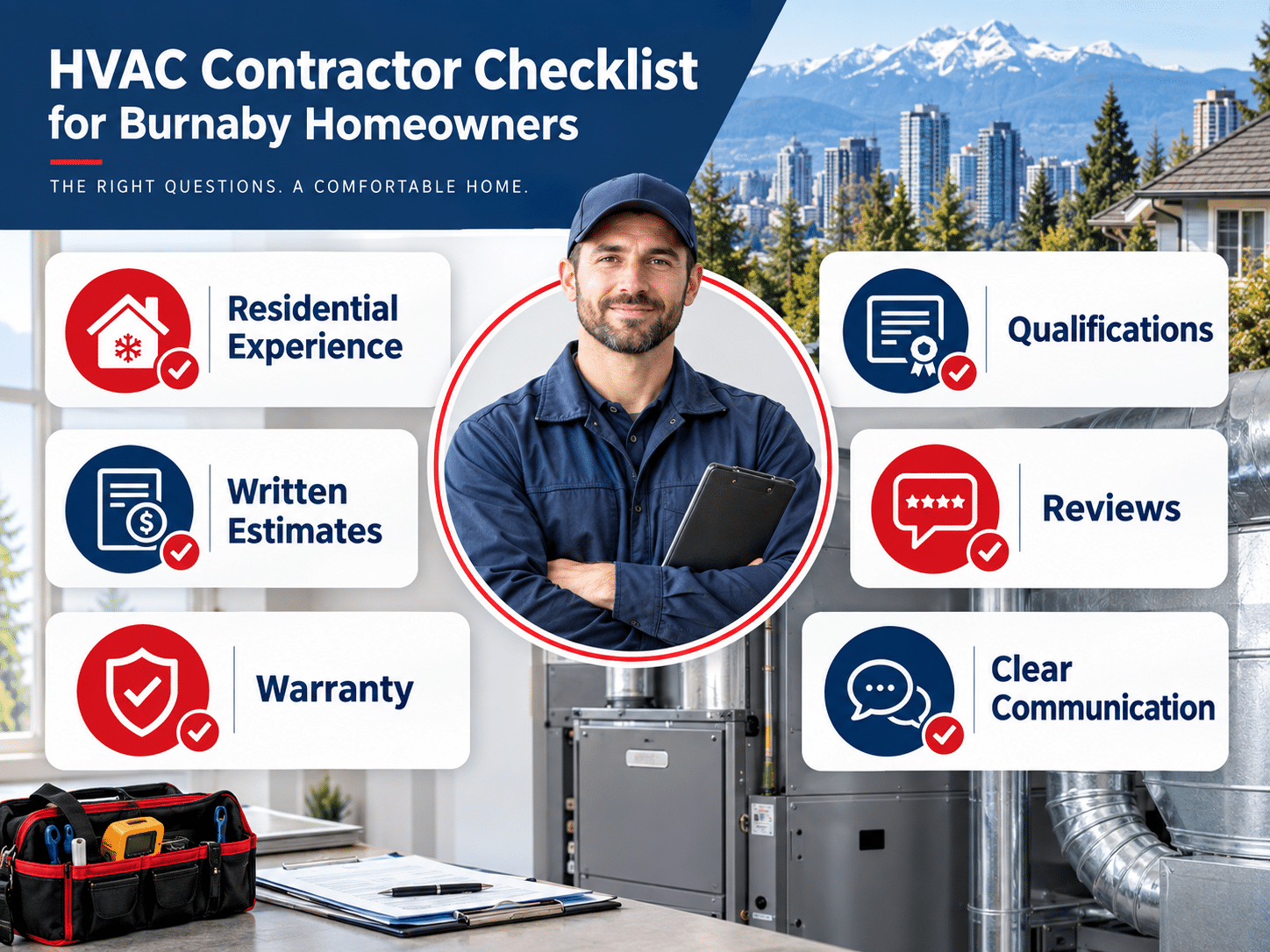
Before hiring an HVAC company in Burnaby, review each option against the same criteria:
- Qualifications and experience: Does the contractor have relevant residential HVAC experience?
- Services: Can the company handle the heating, cooling, maintenance, or repair work your home requires?
- Diagnosis: Has the contractor clearly explained the problem and recommended solution?
- Written quote: Do you understand what equipment, labour, materials, and other work are included?
- Equipment selection: If replacement is involved, has the contractor explained why the proposed system is suitable for your home?
- Warranty: Are equipment and installation warranties clearly explained?
- Communication: Does the contractor answer questions directly and provide clear information?
- Reviews: Do customer reviews show consistent patterns of professional service and workmanship?
- Follow-up: Is there a clear process for maintenance, warranty concerns, or future service?
For major heating or cooling purchases, comparing multiple written quotes can make the decision easier. Natural Resources Canada recommends getting at least three quotes for new home heating equipment and asking contractors to calculate the home’s heating requirements to help ensure proper sizing.
Choose Value Over the Lowest Price
The cheapest quote can be tempting, but the total price does not always tell you what you are getting. One contractor may include more installation work, better equipment, stronger warranty coverage, or more complete service than another.
Instead of asking only, “Who is the cheapest?”, ask, “Which contractor gives me the clearest and most appropriate solution for my home?”
A properly selected and installed HVAC system should fit the home’s requirements. Natural Resources Canada notes that heating and cooling equipment should be selected according to the home’s needs rather than relying on simple sizing assumptions.
For homeowners looking for HVAC services in Burnaby, Canadian Pacific Heating & Cooling provides residential heating and cooling solutions for local homeowners. You can learn more about the company’s HVAC services in Burnaby and the types of HVAC support available for your home.
Conclusion
Choosing the right HVAC company in Burnaby is about more than finding the lowest quote. Homeowners should compare qualifications, residential experience, local knowledge, services, customer reviews, written estimates, warranty coverage, and communication before making a decision. A contractor should also be willing to explain whether repair or replacement makes more sense for the condition of your system.
The right HVAC contractor should make the process easier to understand, not more confusing. Whether you need a repair, maintenance service, new furnace, air conditioner, or heat pump, look for a company that assesses your home’s requirements and clearly explains the recommended solution. Proper equipment selection and sizing are important considerations for long-term comfort and performance.
help determine the right next step.