For BC homeowners replacing an aging heating system, the choice often comes down to heat pump vs furnace BC homes can support. Neither option is automatically right for every property. A heat pump can provide both heating and cooling, while a furnace is designed primarily to provide dedicated heat through the home’s distribution system. The better fit depends on the home and how the system will be used.
This decision matters because heating equipment affects comfort, energy use, maintenance needs, and future replacement planning. Factors such as insulation, ductwork, home size, electrical capacity, outdoor temperatures, and existing cooling equipment can all influence the choice.
This article compares how heat pumps and furnaces work, how they perform in BC’s climate, their benefits and limitations, installation considerations, operating factors, and the situations where replacing a furnace with a heat pump may be worth considering.
Heat Pump vs Furnace: What Is the Difference?
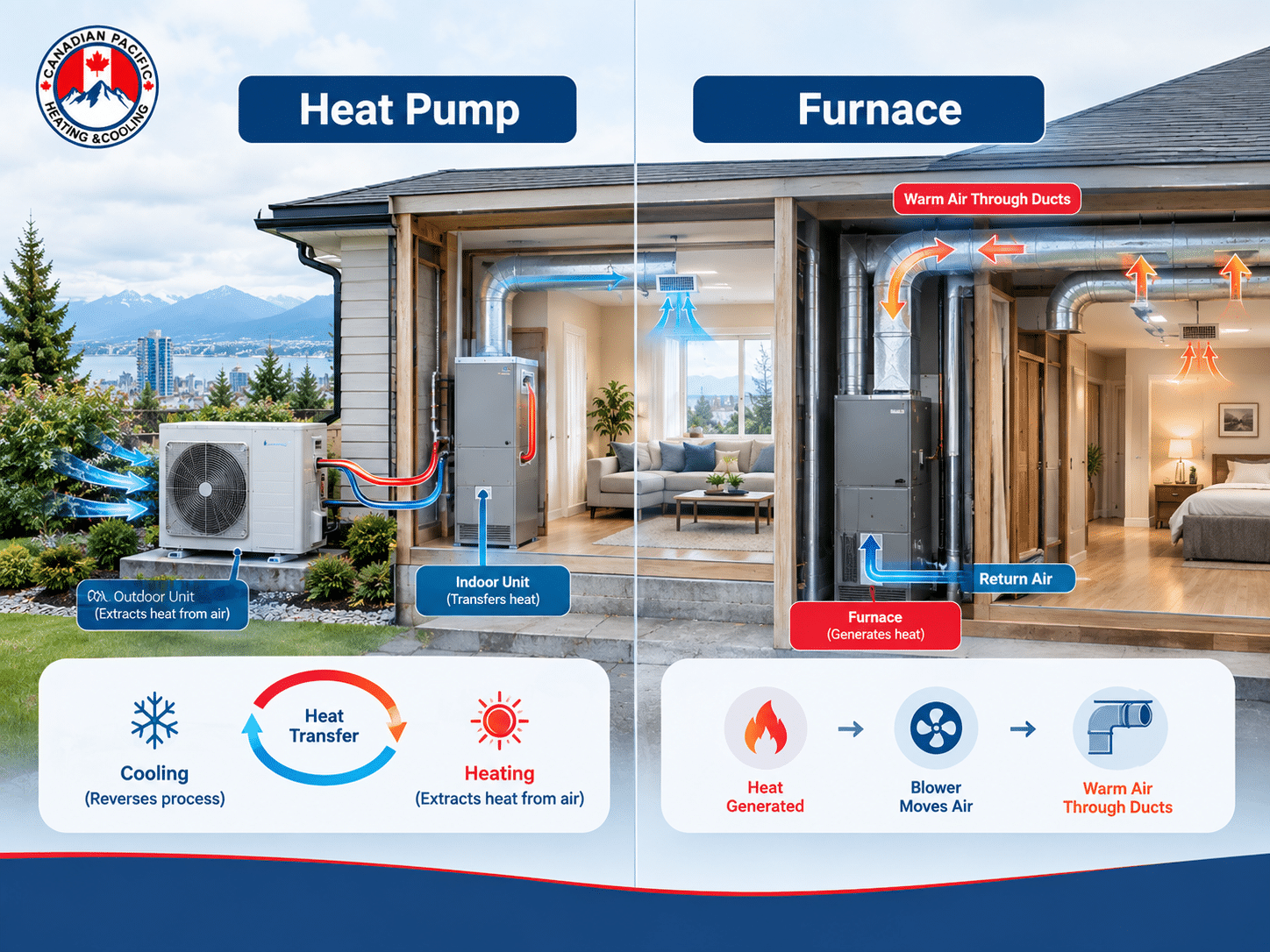
A heat pump and a furnace heat a home in fundamentally different ways. A heat pump moves available heat from one place to another using a refrigeration cycle. During heating mode, it extracts heat from outdoor air and transfers it indoors. The system can reverse this process during warmer weather to provide air conditioning.
A furnace generates heat and then distributes that heated air through the home’s ductwork. Gas furnaces use fuel combustion to produce heat, while other furnace configurations may use different energy sources. Unlike a heat pump, a conventional furnace is primarily a heating appliance and generally needs separate cooling equipment if the home also requires air conditioning.
| Factor | Heat Pump | Furnace |
| Main function | Heating and cooling | Primarily heating |
| Heating method | Transfers heat | Generates heat |
| Cooling | Built into the system | Requires separate cooling equipment |
| Ductwork | May use existing ductwork | Commonly uses ductwork |
| Cold-weather considerations | Capacity varies with outdoor conditions | Designed specifically for heating |
| Installation | Depends on home and existing system | Depends on furnace, ductwork, and existing infrastructure |
| Maintenance | Indoor and outdoor components require care | Furnace and airflow components require care |
How a Heat Pump Works
During heating, the outdoor unit absorbs heat from the surrounding air and transfers it indoors. A compressor and refrigerant circuit allow this heat-transfer process to continue even when outdoor temperatures are low. As temperatures fall, available heat and system capacity can change, which is why equipment selection and sizing matter.
How a Furnace Works
A furnace produces heat and sends warm air through supply ducts into different rooms. The thermostat signals the system when heat is needed, while the blower moves conditioned air through the ductwork. Proper airflow, equipment sizing, maintenance, and duct condition all affect how effectively that heat reaches living spaces.
Heat Pump vs Furnace for BC’s Climate
BC homes experience different heating conditions depending on where they are located. Burnaby and the broader Lower Mainland have relatively moderate winters compared with many colder parts of the province, but outdoor temperatures still affect heating equipment performance. That makes system selection more than a simple comparison of equipment labels.
Can Heat Pumps Handle BC Winters?
Modern heat pumps are available in designs intended for colder outdoor temperatures. They can continue extracting heat from outdoor air as temperatures fall, although their heating capacity and efficiency can change under colder conditions. The specific model, installation, controls, and system sizing all matter.
A properly selected system should be matched to the home’s heating requirements rather than chosen solely because it is marketed as a cold-climate heat pump. Insulation, windows, air leakage, and ductwork also influence how much heat the home needs.
When a Furnace May Make Sense
A furnace can remain a practical option for a home that already has suitable ductwork and infrastructure. Homeowners may also prefer a dedicated heating system or want to maintain a familiar setup. The condition of the existing furnace, current cooling equipment, and planned future upgrades should all be considered before choosing a replacement.
Why Home-Specific Assessment Matters
Two homes in the same neighbourhood can have very different heating requirements. Home size, insulation, windows, floor plan, ductwork, electrical capacity, and existing equipment can all affect the appropriate system. For heat pump vs furnace BC decisions, evaluating the entire property provides a more useful basis for replacement planning than comparing equipment specifications alone.
Heat Pump Benefits for BC Homeowners
Heat pumps are increasingly considered when homeowners need to replace aging heating equipment because they can address both heating and cooling needs. Instead of producing heat through combustion, a heat pump transfers heat between the indoors and outdoors. This operating approach can make it a useful option for homes where homeowners want to combine heating and air conditioning in one system.
Heating and Cooling From One System
One of the main heat pump benefits is its ability to provide both heating and cooling. During colder months, the system moves heat indoors. During warmer weather, it reverses the refrigeration cycle and removes heat from the home. This can be relevant for homeowners who do not currently have central air conditioning or who are planning to replace separate heating and cooling equipment.
Energy-Efficiency Considerations
A heat pump moves heat rather than relying solely on generating it. Its efficiency can vary with the outdoor temperature, equipment model, installation quality, system sizing, and operating conditions. Homeowners should therefore compare published efficiency specifications and expected system use instead of assuming that every heat pump will deliver the same operating results.
Reduced Dependence on Conventional Fuel-Based Heating
A heat pump powered by electricity does not use fuel combustion as its primary heating method. For homeowners considering a change from conventional fuel-based heating, this difference can be an important part of the replacement discussion. Actual energy use and costs still depend on the home’s characteristics, equipment performance, utility rates, and how the system is operated.
Heat pump performance depends on more than the equipment’s efficiency rating. Proper sizing, refrigerant-system design, airflow, outdoor-unit placement, and the home’s insulation can all affect how effectively the system heats and cools the property.
Benefits of Choosing a Furnace
A furnace remains a practical heating option for many homes, particularly properties already designed around ducted furnace heating. Replacing an aging unit with a properly sized, efficient furnace can build on existing infrastructure while maintaining a familiar heating setup. The decision should account for the complete system rather than equipment type alone.
Familiar Heating Technology
- A furnace provides dedicated heating through the home’s ductwork.
- Homeowners with an established ducted system may already have suitable distribution infrastructure.
- Familiar controls and operating patterns can make a furnace replacement straightforward for some households.
- Furnace performance depends on equipment condition, sizing, airflow, and installation quality.
Dedicated Heating Performance
A furnace is designed specifically to heat the home. When the thermostat calls for heat, the furnace produces warm air and the blower distributes it through the supply ducts. Consistent comfort still depends on proper airflow, duct condition, insulation, and an appropriately sized system.
When Furnace Replacement May Make Sense
A furnace replacement may warrant consideration when the existing unit is aging, unreliable, or experiencing increasingly frequent repairs. Existing ductwork and the home’s configuration can also influence the practicality of staying with furnace-based heating. Homeowners should also consider whether they need cooling and whether their existing air conditioner is approaching replacement.
The comparison should include the home’s current infrastructure, future heating and cooling requirements, installation work, energy use, and maintenance needs rather than focusing only on the furnace’s purchase price.
Heat Pump vs Furnace: Key Factors to Compare
Choosing between these heating options requires looking beyond the equipment price. Installation requirements, energy use, heating performance, cooling needs, maintenance, and the condition of the existing system can all change the overall picture.
| Factor | Heat Pump | Furnace |
| Installation | May require outdoor-unit placement, electrical work, and compatible indoor components | May build on existing ductwork and furnace infrastructure |
| Operating costs | Depend on electricity rates, efficiency, outdoor temperature, and usage | Depend on fuel costs, efficiency, thermostat settings, and usage |
| Heating performance | Capacity and efficiency can change as outdoor temperatures fall | Designed as a dedicated heating appliance |
| Cooling | Provides heating and cooling | Requires separate air-conditioning equipment |
| Maintenance | Filters, airflow, outdoor components, refrigerant circuit, and electrical components need attention | Filters, airflow, combustion-related components, and furnace operation require inspection |
| Long-term planning | Consider heating, cooling, electrical requirements, and equipment condition | Consider furnace age, repair history, cooling equipment, and future replacement needs |
Upfront Installation Requirements
The installation scope can vary considerably between homes. A heat pump installation may involve outdoor-unit placement, electrical requirements, indoor components, and modifications to existing equipment. Furnace replacement may involve removal of the old unit, connections to existing infrastructure, and ductwork adjustments where necessary.
Energy Use and Operating Costs
Neither system has a universal operating-cost advantage for every property. Electricity or fuel rates, equipment efficiency, outdoor conditions, home insulation, thermostat settings, and maintenance all affect actual energy use.
Heating Performance
Heating performance depends heavily on correct sizing. An oversized or undersized system can affect comfort and operating performance, regardless of technology. Heat pumps may also require consideration of capacity at lower outdoor temperatures.
Cooling Requirements
A heat pump can provide cooling as part of its normal operation. A conventional furnace primarily provides heating, so a home needing air conditioning generally requires separate cooling equipment.
Maintenance and Lifespan
Both systems require routine maintenance and attention to airflow. Homeowners should consider equipment age, repair frequency, maintenance history, performance changes, and future heating and cooling needs when planning replacement.
Should You Replace Your Furnace With a Heat Pump?
Replacing a furnace is an opportunity to reassess the home’s entire heating and cooling setup. A heat pump may be worth considering when homeowners want heating and cooling from one system, while a new furnace may make more sense when the existing configuration remains well suited to the property. A dual-fuel system is another possible approach.
A Heat Pump May Be Worth Considering If…
- You need both heating and cooling and want one system to provide both.
- Your existing heating equipment is approaching the end of its useful service life.
- Energy efficiency is an important consideration.
- The home’s electrical system and physical layout can support the proposed installation.
- You are interested in moving away from conventional fuel-based heating.
- The home’s insulation, ductwork, and heating requirements are suitable for the system.
A Furnace Replacement May Be Worth Considering If…
- Your existing ducted configuration is well suited to furnace heating.
- You prefer a dedicated heating appliance.
- Existing infrastructure makes furnace replacement practical.
- Your home’s heating requirements and current cooling setup align with a furnace-based configuration.
- You want to replace unreliable equipment without changing the overall heating technology.
When a Dual-Fuel or Hybrid Approach May Be Considered
Some homes can use a heat pump together with a furnace. In a dual-fuel configuration, controls determine when the heat pump or furnace operates based on system settings and operating conditions. This approach can provide homeowners with another way to combine heating technologies, but proper equipment sizing, controls, installation, and system design are essential.
Signs Your Current Heating System May Need Replacement
A heating system does not necessarily need replacement simply because it has developed a problem. However, certain patterns can indicate that continued repairs may no longer be the most practical long-term approach. Looking at the system’s age, reliability, comfort performance, and energy use together gives homeowners a clearer picture.
Frequent or Increasing Repairs
Repeated breakdowns can become frustrating and expensive, particularly when several components begin requiring attention. If repair frequency is increasing or individual repair costs are accumulating, it may be worth comparing the cost and expected reliability of replacement equipment with continued repairs.
Uneven or Inadequate Heating
Cold rooms, temperature fluctuations, weak airflow, or difficulty maintaining the thermostat setting can indicate equipment or distribution problems. These symptoms can also result from ductwork, insulation, air leakage, or sizing issues, so replacing the heating unit alone may not resolve the underlying problem.
Rising Energy Use
An increase in energy consumption can have several causes, including changing household usage, weather, insulation problems, airflow restrictions, or equipment performance. A professional assessment can help determine whether the heating system is contributing to the change.
Aging Equipment
Older equipment may become less reliable and can eventually become harder or more expensive to repair. Parts availability, maintenance history, performance, and the home’s future heating and cooling requirements are useful considerations when deciding whether to plan a replacement.
Before replacing an aging heating system, identify why comfort or performance has declined. Checking airflow, ductwork, insulation, and system sizing can help prevent installing new equipment that does not address an underlying home-performance problem.
What Should BC Homeowners Consider Before Replacing a Heating System?
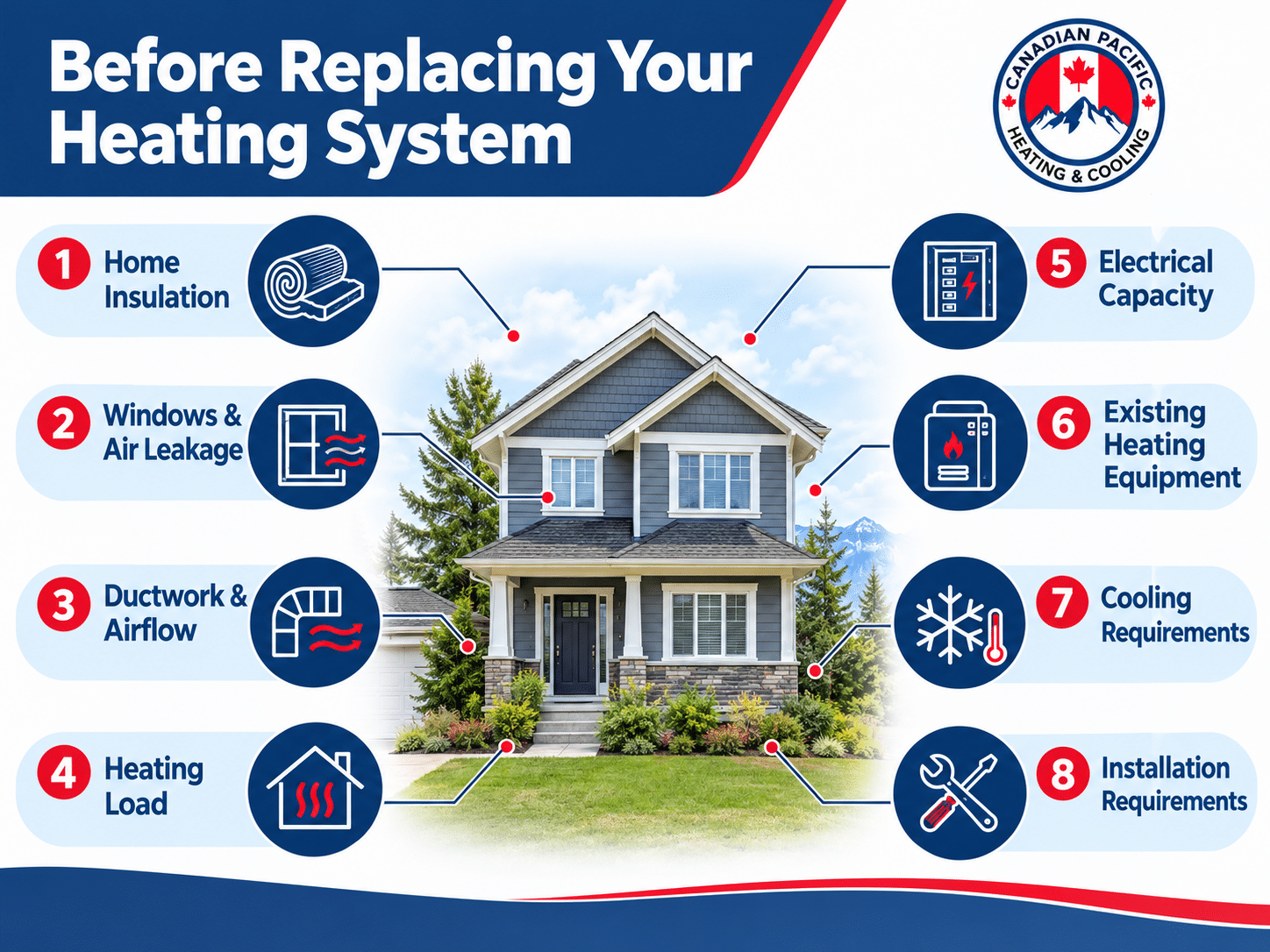
A heating-system replacement is also an opportunity to look at how the home performs as a whole. Choosing equipment based only on the capacity or technology of the existing unit can overlook issues that affect comfort and energy use. A broader assessment helps homeowners compare realistic replacement options.
Evaluate the Whole Home
- Insulation: Poor insulation can increase heating demand regardless of equipment type.
- Windows and air leakage: Drafts and heat loss can make rooms harder to keep comfortable.
- Ductwork: Leaks, restrictions, or poor balancing can affect airflow throughout the home.
- Floor plan: Home size and layout influence heating distribution.
- Existing equipment: The condition of the furnace, air conditioner, thermostat, and related components matters.
Determine the Home’s Heating Load
Equipment should be sized according to the property’s actual heating requirements rather than simply replacing an old unit with the same capacity. A heating-load assessment considers factors such as the home’s size, insulation, windows, climate exposure, and air leakage. Correct sizing helps the system operate as intended and maintain more consistent indoor temperatures.
Consider Heating and Cooling Together
Think about whether the home needs air conditioning now or may need it in the future. A heat pump provides both functions, while a conventional furnace generally needs separate cooling equipment. If an existing air conditioner is also aging, considering both systems together can provide a clearer replacement picture.
Compare the Full Cost of Ownership
Look beyond the initial installation price. Compare expected energy use, maintenance, potential repairs, equipment life, installation requirements, and future replacement needs.
Conclusion: Choosing the Right Heating Option for Your BC Home
When comparing heat pump vs furnace BC homeowners should look beyond the equipment itself. Heat pumps can provide both heating and cooling, while furnaces offer dedicated heating and may work well with an existing ducted configuration. Both technologies can be appropriate, depending on the property’s requirements and the homeowner’s priorities.
BC climate, home size, insulation, air leakage, ductwork, electrical capacity, existing equipment, cooling requirements, and expected operating conditions can all affect the decision. Installation requirements, maintenance, repair history, and long-term ownership costs also deserve consideration.
Replacing a heating system is a significant home investment, so choosing equipment based solely on an online comparison or the capacity of an old unit may overlook important factors. A professional assessment can help identify the home’s heating load and determine which system configurations are suitable.