When energy bills start climbing, many homeowners immediately wonder whether their furnace, heat pump, or air conditioner is becoming inefficient. Sometimes the equipment is part of the problem, but higher energy costs can also be linked to restricted airflow, dirty components, thermostat settings, ductwork issues, changing weather, or increased household demand.
Regular HVAC maintenance can help keep your heating and cooling system operating as intended. By addressing airflow restrictions, checking system components, identifying developing problems, and keeping equipment in good operating condition, maintenance can support better efficiency and help avoid unnecessary energy use.
For homeowners in Burnaby and throughout British Columbia, maintaining HVAC equipment is particularly important because heating systems can operate extensively during the colder months. The goal is not to promise a specific reduction in your energy bill, but to make sure your HVAC system is not using more energy than necessary because of avoidable performance problems.
Can HVAC Maintenance Really Reduce Energy Bills?
Yes, HVAC maintenance can support lower energy costs by helping a heating and cooling system operate efficiently. However, the amount a homeowner saves depends on the condition of the equipment, how the system is used, the home’s insulation and ductwork, thermostat settings, weather, and several other factors.
A well-maintained system is generally better positioned to provide the required heating or cooling without unnecessary performance problems.
For example, a heavily restricted air filter can reduce airflow. Poor airflow can affect how effectively a system distributes conditioned air and may contribute to longer or less effective operating cycles. Addressing the restriction is one small but important part of maintaining HVAC efficiency.
How Maintenance Affects HVAC Energy Consumption
HVAC energy use is influenced by how much work the system has to perform to maintain the temperature you have selected.
A simplified relationship looks like this:
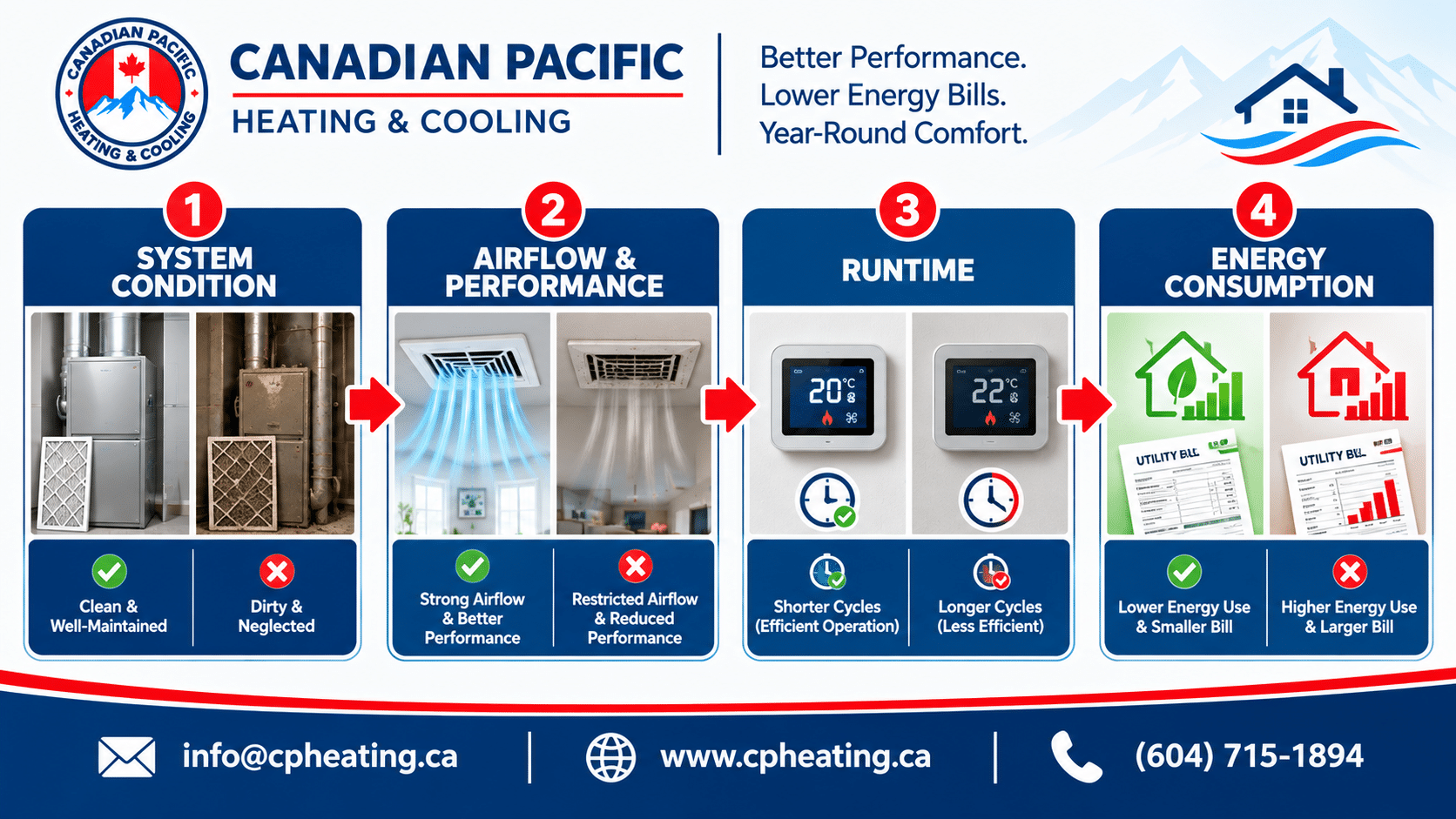
When equipment is dirty, airflow is restricted, components are wearing, or another problem affects operation, the system may not perform as efficiently as it should.
Professional maintenance provides an opportunity to inspect the equipment, identify potential concerns, and address maintenance needs before they become more significant performance issues.
Why a Poorly Maintained HVAC System May Use More Energy
HVAC systems are made up of multiple components that need to work together. A problem with one part of the system can affect overall performance.
Maintenance does not guarantee lower energy bills, but neglecting basic maintenance can allow avoidable problems to continue unnoticed.
Restricted Airflow Makes the System Work Harder
Airflow is fundamental to HVAC performance.
A dirty filter, blocked return grille, obstructed supply register, dirty blower component, or duct restriction can interfere with air movement. When conditioned air cannot move properly through the system, the equipment may struggle to deliver the expected comfort.
Homeowners should regularly check that supply vents and return air grilles are not blocked by furniture, rugs, curtains, or other household items.
Filters should also be checked according to the manufacturer’s recommendations. A filter that is visibly dirty or heavily restricted may need attention sooner than expected, depending on the household and equipment.
Dirty HVAC Components Can Affect Performance
Dust and debris naturally accumulate in HVAC systems over time. Certain components require professional inspection and cleaning to maintain proper operation.
When buildup affects airflow or heat transfer, system performance can suffer.
This is one reason professional HVAC maintenance goes beyond simply changing an air filter. A technician can evaluate components that homeowners cannot safely or accurately assess themselves.
Small HVAC Problems Can Become Efficiency Problems
An HVAC system does not always fail suddenly.
Sometimes performance changes gradually. A homeowner may notice longer operating cycles, weaker airflow, unusual sounds, or inconsistent temperatures before a larger problem develops.
These changes do not necessarily mean the equipment needs to be replaced. They do mean the system deserves attention.
Identifying a developing issue early can help determine whether a maintenance adjustment, repair, or further diagnostic work is appropriate.
10 HVAC Maintenance Steps That Can Support Lower Energy Costs
HVAC maintenance savings are not produced by one single task. Instead, efficiency is supported by keeping the entire system and its operating conditions in good shape.
1. Replace or Clean the Air Filter as Recommended
The air filter plays an important role in maintaining airflow.
A heavily loaded filter can restrict the amount of air moving through the system. That can affect heating and cooling performance and may contribute to increased system runtime.
Check your filter regularly and follow the recommendations provided by the HVAC equipment manufacturer. Homes with pets, renovations, higher dust levels, or other conditions may require more frequent attention.
Do not assume that a thicker or more restrictive filter is automatically better. The filter should be appropriate for the HVAC system.
2. Keep Supply Vents and Return Air Grilles Clear
Your HVAC system needs both supply and return airflow.
If furniture is pushed against a return grille or a supply register is covered by a rug or other object, airflow can be affected.
Walk through your home periodically and make sure:
- Supply registers are unobstructed.
- Return grilles have adequate clearance.
- Furniture is not blocking airflow.
- Curtains are not covering vents.
- Household items are not being stored around registers.
These simple checks can help maintain proper air distribution.
3. Schedule Professional HVAC Maintenance
Homeowner checks are useful, but they do not replace professional HVAC maintenance.
Professional service can involve evaluating equipment operation, airflow, electrical components, mechanical condition, controls, and other system-specific components.
The exact maintenance process depends on whether your home uses a furnace, heat pump, air conditioner, or another HVAC configuration.
Regular maintenance also gives homeowners an opportunity to discuss changes in system performance with a qualified HVAC professional.
4. Keep Outdoor Heat Pump Equipment Clear
Heat pumps rely on outdoor airflow to transfer heat.
Leaves, vegetation, debris, and other obstructions around the outdoor unit can interfere with airflow.
Keep the area around the unit reasonably clear and monitor it throughout the year. In winter, homeowners should also pay attention to conditions that could interfere with normal operation.
If you are unsure whether an issue with the outdoor unit is normal or requires service, have it evaluated by an HVAC professional rather than attempting complex repairs yourself.
5. Check Thermostat Operation
Your thermostat controls when your HVAC system operates and what temperature it attempts to maintain.
Unnecessary heating or cooling can increase energy consumption, while an incorrectly operating thermostat can cause comfort and performance problems.
Review your programmed temperature settings and make sure they reflect how your household actually uses the home.
A programmable or smart thermostat can also help homeowners manage temperature schedules more conveniently.
6. Pay Attention to Uneven Heating or Cooling
If one room is consistently much warmer or colder than another, do not simply assume that the HVAC equipment is too small or too old.
Uneven temperatures can have several possible causes, including:
- Restricted airflow
- Ductwork problems
- Poor insulation
- Air leakage
- Building-envelope issues
- Thermostat location
- Equipment performance
Identifying the actual cause is more useful than simply increasing or decreasing the thermostat setting.
7. Inspect Accessible Ductwork for Problems
Ductwork carries conditioned air throughout the home.
Visible damage, disconnected sections, gaps, or inadequate insulation can affect how effectively air reaches different areas of the house.
Homeowners can visually inspect accessible ductwork for obvious problems, but concealed ducts and more complex airflow issues may require professional assessment.
If certain rooms consistently receive less heating or cooling, ductwork should be considered as part of the overall investigation.
8. Keep the HVAC Area Accessible and Clean
HVAC equipment should not be surrounded by unnecessary storage or clutter.
Keeping the equipment area accessible makes inspections and maintenance easier and helps homeowners notice changes around the system.
Do not place household items where they could interfere with equipment operation, access, or safety.
9. Pay Attention to Unusual System Behaviour
Your HVAC system can sometimes indicate a problem before it stops working completely.
Pay attention to changes such as:
- Longer operating cycles
- Frequent cycling
- Weak airflow
- Unusual sounds
- Unexpected temperature changes
- Poor heating or cooling performance
A change does not automatically indicate an expensive repair. It simply means the system should be assessed rather than ignored.
10. Keep a Regular Maintenance Schedule
HVAC maintenance works best as an ongoing part of home care.
Waiting until the system stops working can mean that a developing performance issue has already become more serious.
Follow the equipment manufacturer’s recommendations and consider the specific needs of your home, equipment, and usage patterns when determining an appropriate maintenance schedule.
Which HVAC Problems Can Increase Energy Costs?
Several HVAC-related issues can contribute to increased energy consumption.
A Dirty or Restricted Air Filter
A restricted filter can reduce airflow through the HVAC system.
If you notice that your filter becomes dirty quickly or airflow changes after the filter becomes loaded, investigate the cause rather than repeatedly ignoring the issue.
Ductwork Air Leakage
Air can be lost through damaged, disconnected, or poorly sealed ductwork.
This can contribute to uneven temperatures and reduced delivery of conditioned air to occupied spaces.
Professional ductwork evaluation may be appropriate when airflow problems persist.
Poor Airflow
Poor airflow can originate from several sources.
Possible causes include:
- Filter restrictions
- Blocked returns
- Obstructed registers
- Dirty components
- Duct restrictions
- Mechanical problems
Because there are multiple possible causes, homeowners should avoid assuming that changing the thermostat will solve the underlying problem.
Aging or Worn HVAC Components
Older equipment is not automatically inefficient simply because of its age.
However, wear and deterioration can affect performance over time. An older system with repeated repairs, declining comfort, unusual operation, or poor performance may warrant a professional evaluation.
Incorrect Thermostat Settings or Operation
Temperature settings directly influence how often your HVAC equipment operates.
If the thermostat is programmed in a way that creates unnecessary heating or cooling demand, energy use can increase.
Review your schedule and adjust it based on your household’s actual needs.
Does HVAC Maintenance Save More Money Than It Costs?
This is a reasonable question for any homeowner considering professional maintenance.
The answer depends on the system.
Maintenance is valuable not simply because it may reduce energy consumption, but because it helps homeowners understand the condition of their equipment and address maintenance needs before they become larger concerns.
What Maintenance Can Help Prevent
Regular maintenance may help identify:
- Airflow problems
- Worn components
- Electrical concerns
- Operational issues
- Dirty components
- Performance changes
- Other developing equipment problems
Maintenance cannot prevent every HVAC failure, and it cannot guarantee a particular energy saving.
Why Energy Savings Vary From Home to Home
Two homes with identical HVAC equipment can have very different energy bills.
Factors include:
- Home size
- Insulation
- Windows and doors
- Ductwork
- Thermostat settings
- Outdoor temperature
- Household occupancy
- HVAC equipment
- Equipment condition
- Heating and cooling habits
For that reason, homeowners should be cautious about claims that maintenance will automatically reduce their energy bill by a specific percentage.
Maintenance Is Not the Same as Guaranteed Energy Savings
The purpose of HVAC maintenance is to support proper system operation, identify maintenance needs, and help maintain equipment condition.
If a system is already operating properly, the immediate energy savings from maintenance may be limited. If significant maintenance or airflow problems are found, addressing them may have a more noticeable effect on system performance.
How HVAC Maintenance Improves Heating Efficiency in BC Homes
Heating efficiency is particularly relevant in British Columbia because homeowners depend on their heating systems during the colder part of the year.
For Burnaby homeowners, efficient operation is about more than simply reducing energy costs. It also contributes to consistent indoor comfort and reliable heating performance.
Why Heating Efficiency Matters During Burnaby Winters
When outdoor temperatures drop, heating systems may operate for extended periods to maintain indoor temperatures.
If airflow is restricted or equipment is not operating properly, the system may struggle to provide the desired comfort.
Regular maintenance can help homeowners identify issues that may affect heating performance before the system is placed under heavier seasonal demand.
Furnace Maintenance and Energy Efficiency
Furnace maintenance can involve checking system operation, airflow, controls, electrical components, and other equipment-specific areas.
Homeowners should not attempt to inspect or service combustion or electrical components themselves.
If a furnace behaves differently than normal, professional evaluation can help determine whether the issue is maintenance-related, a repair concern, or something else affecting performance.
Heat Pump Maintenance and Efficiency
Heat pumps require both indoor and outdoor components to work together.
Maintaining appropriate airflow and keeping the outdoor equipment clear are important parts of routine care.
If a heat pump is producing unusual sounds, providing inconsistent comfort, or behaving differently from normal, a professional assessment can help determine the cause.
Homeowner HVAC Maintenance vs. Professional Maintenance
Knowing what you can safely do yourself is just as important as knowing when to call an HVAC professional.
Maintenance Tasks Homeowners Can Handle
Homeowners can generally take care of basic tasks such as:
- Checking the air filter
- Replacing the filter when appropriate
- Keeping supply vents clear
- Keeping return grilles unobstructed
- Checking thermostat settings
- Keeping the outdoor heat pump area clear of obvious debris
- Monitoring changes in system performance
These simple habits can help homeowners identify problems sooner.
What Should Be Left to an HVAC Professional?
More technical work should be handled by a qualified HVAC professional.
This may include:
- Electrical diagnostics
- Refrigerant-related service
- Internal equipment inspection
- Combustion and safety checks
- Mechanical diagnostics
- Complex airflow testing
- Component replacement
- Equipment repair
Attempting technical HVAC work without the required knowledge and equipment can create safety risks and may damage the system.
Signs Your HVAC System May Be Losing Efficiency
Sometimes the first indication of an HVAC problem is a change in how the system behaves.
Your Energy Bills Are Increasing Without a Clear Change in Usage
An unexpected increase in energy costs deserves investigation.
Do not automatically assume the furnace or heat pump is failing. Weather, thermostat settings, household usage, insulation, ductwork, and utility rates can all affect your bill.
However, if higher energy costs occur alongside declining HVAC performance, maintenance or professional diagnosis may be worthwhile.
The HVAC System Runs for Long Periods
Long operating cycles can be normal during particularly cold or hot weather.
But if your system suddenly runs much longer than it normally does, possible causes may include:
- Thermostat settings
- Outdoor conditions
- Airflow restrictions
- Heat loss
- Equipment problems
- Increased household demand
A professional can help determine which factor is involved.
Rooms Feel Unevenly Heated or Cooled
Persistent temperature differences can indicate airflow or ductwork problems, but they can also be related to insulation, windows, room layout, or other building characteristics.
The solution depends on the underlying cause.
The System Makes Unusual Sounds
New or unusual noises should not simply be ignored.
Grinding, rattling, squealing, or other unexpected sounds can indicate a component problem that requires assessment.
Airflow Feels Weak
If airflow from the registers suddenly feels weaker than usual, start with simple checks such as the filter and visible vent obstructions.
If the problem continues, professional HVAC diagnosis may be necessary.
How to Lower Energy Costs Beyond HVAC Maintenance
HVAC maintenance is only one part of home energy efficiency.
Improve Thermostat Scheduling
Use temperature schedules that match your household’s routine.
Avoid unnecessary heating or cooling when the home does not require it, while still maintaining temperatures that are appropriate for the occupants and the home.
Address Air Leaks Around Windows and Doors
Heat can escape through gaps around windows, doors, and other parts of the building envelope.
Weatherstripping, sealing, and other appropriate improvements can complement HVAC efficiency measures.
Review Home Insulation
Insulation affects how effectively your home retains conditioned air.
If your HVAC system appears to be operating normally but the home loses heat quickly, the building envelope may deserve attention.
Keep HVAC Vents and Returns Unblocked
This simple step costs nothing and can help maintain proper airflow throughout the home.
Consider Ductwork Condition
Ductwork problems can affect how efficiently conditioned air reaches occupied spaces.
If some areas of your home consistently have poor airflow or temperature differences, consider having the duct system evaluated.
When Should You Repair or Replace an Inefficient HVAC System?
High energy costs alone do not automatically mean that HVAC replacement is necessary.
The right decision depends on the equipment’s condition and the cause of the performance problem.
When Repair May Make Sense
Repair may be appropriate when:
- The problem is identifiable and repairable.
- The equipment is otherwise in reasonable condition.
- The repair provides a practical solution.
- The system has a history of reliable operation.
A professional diagnosis can help determine whether repair is reasonable.
When Replacement May Be Worth Considering
Replacement may deserve consideration when a system has:
- Frequent breakdowns
- Repeated repair needs
- Significant deterioration
- Persistent performance problems
- Poor overall condition
- Difficulty meeting the home’s heating or cooling requirements
Replacement should be considered as part of a broader evaluation rather than simply because an HVAC system is older.
Simple HVAC Energy-Saving Maintenance Checklist
Use this checklist to keep track of basic HVAC efficiency practices:
- Check the air filter regularly.
- Replace the filter according to manufacturer guidance.
- Keep supply vents unobstructed.
- Keep return air grilles clear.
- Review thermostat settings and schedules.
- Keep outdoor heat pump equipment clear of obvious debris.
- Watch for unusual sounds.
- Pay attention to weak or changing airflow.
- Monitor unexplained changes in energy consumption.
- Schedule professional HVAC maintenance.
- Investigate recurring comfort or performance problems.
These steps do not guarantee a lower energy bill, but they can help you maintain better awareness of your HVAC system and address potential problems sooner.
Reduce HVAC Energy Costs With Proper Maintenance
HVAC maintenance is not a magic solution for every high energy bill. Your home’s insulation, windows, doors, ductwork, thermostat settings, weather, equipment, and daily habits all influence energy consumption.
However, keeping your HVAC system properly maintained can help support efficient operation and give you a better understanding of its condition. Basic homeowner checks, appropriate filter care, clear airflow paths, and professional maintenance can all contribute to a healthier HVAC system.
If your energy costs have increased alongside longer runtimes, weak airflow, uneven temperatures, unusual sounds, or other changes in HVAC performance, it is worth finding out why rather than assuming replacement is the only answer.
For homeowners in Burnaby and surrounding communities, Canadian Pacific Heating & Cooling can help assess HVAC performance and determine whether maintenance, repair, or another heating and cooling solution is appropriate.
Need help with your HVAC system? Contact Canadian Pacific Heating & Cooling to discuss professional HVAC maintenance and identify potential efficiency or performance concerns in your home.